 Aeronautics
Software-Defined Vehicles: How Centralization and Continuous Updates Are sustainably transforming the Automotive Industry

Interview with Rabi Malki, Project Manager by in-motion
The automotive industry is undergoing a profound transformation: Software-Defined Vehicles (SDV) are turning cars into dynamic platforms that evolve through continuous updates. In this interview, Rabi Malki, Project Manager at in-motion, explains how this paradigm shift is revolutionizing traditional vehicle architecture from the centralization of control units to new challenges in validation and development.
With the rise of Software-Defined Vehicles, software functions, data, and continuous updates are becoming increasingly important compared to traditional hardware. How do you assess this paradigm shift, and what opportunities and challenges does it create?
Of course. You have to imagine that, in the past, vehicles had all their functions defined during the planning phase and were developed accordingly. Many functions or functional areas had their own dedicated control units, each responsible for specific tasks. While these ECUs could be updated, the overall architecture was highly decentralized.
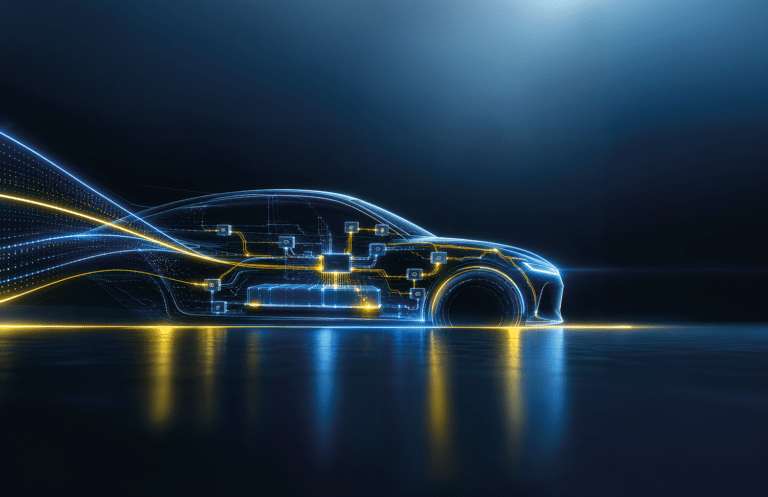
The Software-Defined Vehicle has fundamentally changed this approach. Vehicle architecture is becoming increasingly centralized. Vehicles are no longer static but can continue to evolve even after delivery. Individual functions are no longer distributed across numerous small ECUs; instead, they are controlled by powerful central computing units.
These systems manage a wide range of functionalities, coordinate different vehicle domains, and can be continuously enhanced. This represents one of the greatest opportunities offered by the Software-Defined Vehicle.
With Software-Defined Vehicles, vehicle functions are no longer developed and released just once but are continuously expanded and optimized through software. Why does this make validation significantly more complex, and what challenges does it create for development and testing?
Exactly, validation becomes significantly more complex because functions can be continuously developed and enhanced. That is the key point. In the past, for example, a lane-keeping assist system was developed, integrated into the vehicle with the necessary sensors and actuators, and optimized until it functioned reliably. Once the vehicle was launched, the function remained largely unchanged throughout its lifecycle. Occasional bug fixes were introduced, but major functional enhancements were rare.
Today, things are different. After delivery, a function can continue to evolve and gain additional capabilities. An existing driver assistance system can gain additional functions through software updates, provided hardware, safety concept, and regulatory approvals allow it, such as enhanced lane-keeping or lane-change assistance features.
Voice assistants also illustrate this shift: through regular updates, they are continually becoming more powerful and capable.
For validation, this means substantially greater complexity. There is more software, more dependencies between individual functions, and a higher degree of integration within centralized control units. This significantly increases the depth of validation. Instead of running hundreds or thousands of test cases per day as we do now, the number can scale, depending on the function, to ten times that amount or more.
In addition, a high level of agility is required. Software updates must sometimes be delivered within very short timeframes, even long after a vehicle’s market launch. That is why shorter development cycles, greater software expertise, and rapid validation of new functions are critical.
The demands on development and validation are continuously increasing with Software-Defined Vehicles. What role do modern test platforms play in this context, and how are they changing the industry from your perspective?
Modern test platforms are playing an increasingly important role. Even in the earliest stages of development, they make it possible to identify defects long before the first vehicle reaches the road.
As software complexity continues to grow, it is crucial to detect issues early and obtain reliable results quickly. The goal is to ensure that the first vehicles built have as few problems as possible and can be used efficiently for further testing and validation.
This trend will continue to intensify as we work with ever larger volumes of data. Comprehensive validation activities can already be performed during the early testing phases. Combined with HIL (Hardware-in-the-Loop) and SIL (Software-in-the-Loop) approaches, testing can be significantly expanded and automated.
This provides deeper insights into the software and enables potential issues to be identified much earlier. For this reason, modern test platforms will play an even more central role in the future.
Software-Defined Vehicles are considered a key driver of automated development and validation processes. How does the software-centric approach support automation throughout the entire vehicle lifecycle from development to over-the-air updates?
Automation is becoming increasingly important due to Software-Defined Vehicles. However, this is by no means an entirely new concept. For many years, we have seen that the customer experience is increasingly shaped by software rather than hardware.
This creates highly customizable vehicles whose functions can be adapted flexibly. At the same time, it requires software development cycles that are significantly shorter than traditional hardware development cycles.
Particularly in validation and verification, we must keep pace with these rapid development cycles. Today, we no longer test only the finished vehicle. Instead, we test software beforehand in virtual and abstract test environments. We first verify whether the software meets requirements before it is even integrated into the vehicle. This allows us to respond much faster and support development cycles more efficiently.
Automation is indispensable for this process. The number of possible use cases and configurations is enormous. This is why Software-Defined Vehicles are a major driver of the increasing demand for automation.
Looking ahead, what role will AI and automation play in Software-Defined Vehicles, and what technological or regulatory challenges does the industry still need to overcome?
Artificial intelligence is a key enabler for validation in the Software-Defined Vehicle environment. It helps us analyze highly complex software, sophisticated functionalities, and diverse failure patterns in significantly less time.
AI can reveal patterns, anomalies, and correlations in large datasets that would be extremely difficult, if not impossible, to detect manually. As a result, it is already an important part of modern development and validation processes and will continue to play a central role in the future.
In addition, AI is becoming increasingly important in the field of cybersecurity. As vehicles become more connected, the risk of external attacks also increases. Therefore, we need intelligent systems capable of continuously monitoring a vehicle’s security status.
As vehicle connectivity increases, so does the risk of external cyberattacks. That’s why we need intelligent systems to continuously monitor a vehicle’s security status. At the same time, regulatory requirements, cybersecurity standards, functional safety, and approval processes must keep pace with the rapid evolution of software-driven development.
A useful comparison is the smartphone. Modern smartphones regularly receive updates that introduce new features, improve security, and enhance the user experience. We are now seeing exactly the same development in vehicles.
A Software-Defined Vehicle is no longer static. It continues to evolve throughout its entire lifecycle. New features can be added, existing functions can be improved, and additional value can be created. As a result, a vehicle can become functionally more capable after purchase than it was on the day it was delivered.
It is still too early to say how far this development will ultimately go. However, the trend is clearly visible.
You want to learn more about in-motion?